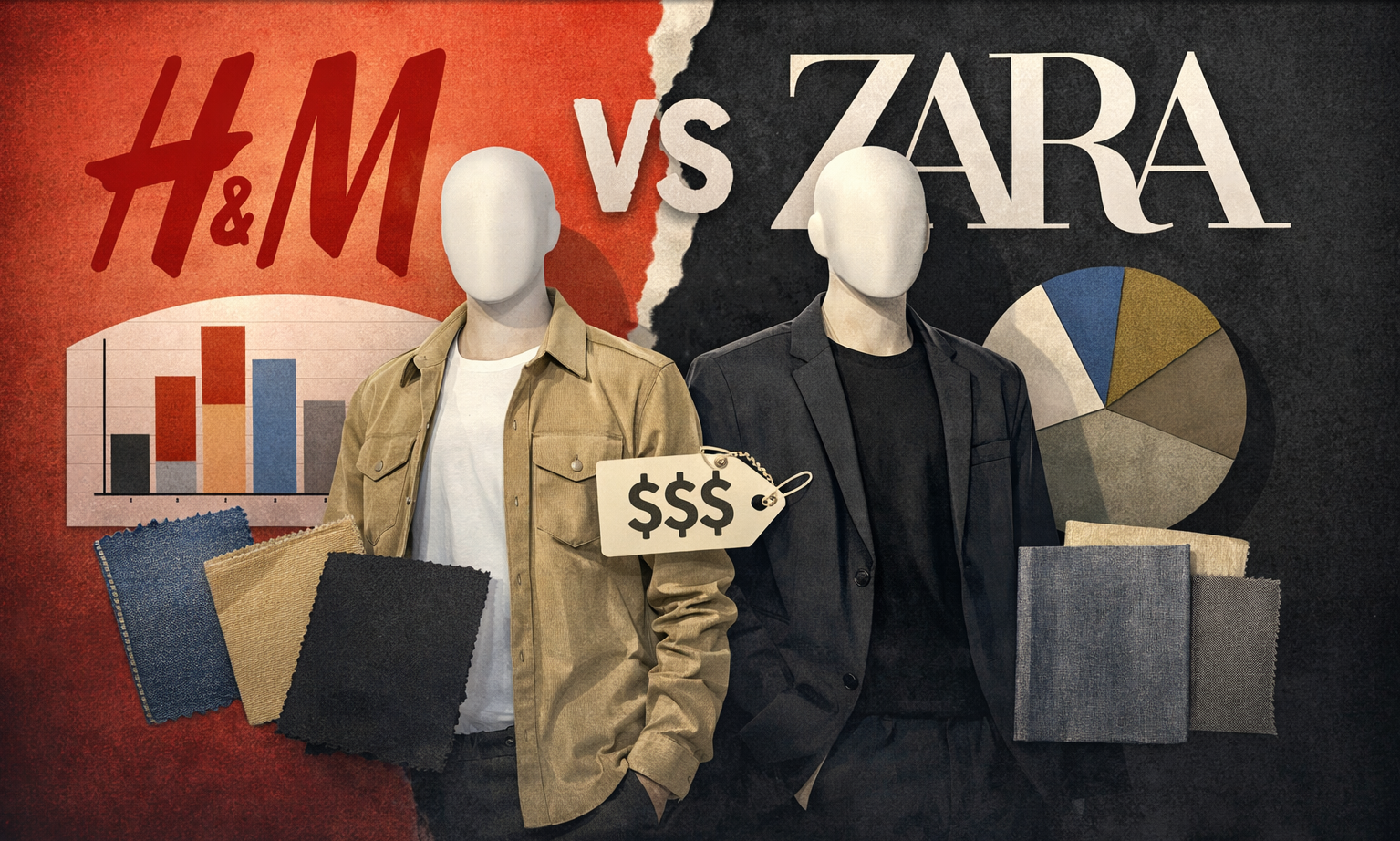
Recently I picked up a blazer from Zara, sharp fit and definitely pricier than I expected. It made me do the thing I always do…compare options.
Zara and H&M are direct competitors in men’s fast fashion. They target the same shoppers with quick-moving drops, but they tend to win in different ways.
So we compared them. Fashion brands don’t exactly hand you clean, analysis-ready data, so we manually pulled publicly visible details for a set of men’s items labelled “best sellers” on both UK websites in December 2025.
Note: “Best seller” here means items the brands label as best sellers on their UK sites, not verified sales ranks. This is a snapshot of those labels. It’s useful for comparing positioning, not a full picture of either brand’s catalogue.
TL;DR: Key Findings
H&M vs Zara at a glance:
| H&M | Zara | |
|---|---|---|
| Average Price | £35 | £73 (2× more expensive) |
| Focus | Everyday basics (jeans, hoodies) | Outerwear (jackets, coats) |
| Materials | More natural fabrics | More synthetic overall |
| Colors | Safe, dark neutrals | Safe, dark neutrals |
Four key insights:
- Zara’s best sellers are outerwear-heavy, while H&M’s skew more toward everyday tops and bottoms.
- Zara is about 2× the price in matched categories (£73 vs £35 on average).
- The plot twist: H&M’s best sellers skew more natural in materials overall, despite being cheaper.
- Colour-wise, both play it safe, which in the UK mostly means dressing like winter is a personality.
What best sellers are really saying
We looked at roughly a hundred best-seller items from H&M and a larger set from Zara (the lists we pulled were 89 and 225). Their “best seller” mix comes out very differently.
H&M’s best sellers are mostly everyday pieces, with bottoms and tops making up most of the list.
Zara’s best sellers are much more outerwear-led: nearly half are jackets/coats/overshirts and similar layers.
If you zoom in:
- H&M’s list is anchored by jeans and trousers, with casual tops like hoodies and jumpers close behind.
- Zara’s list is anchored by jackets first, then trousers, knitwear, and shirts.
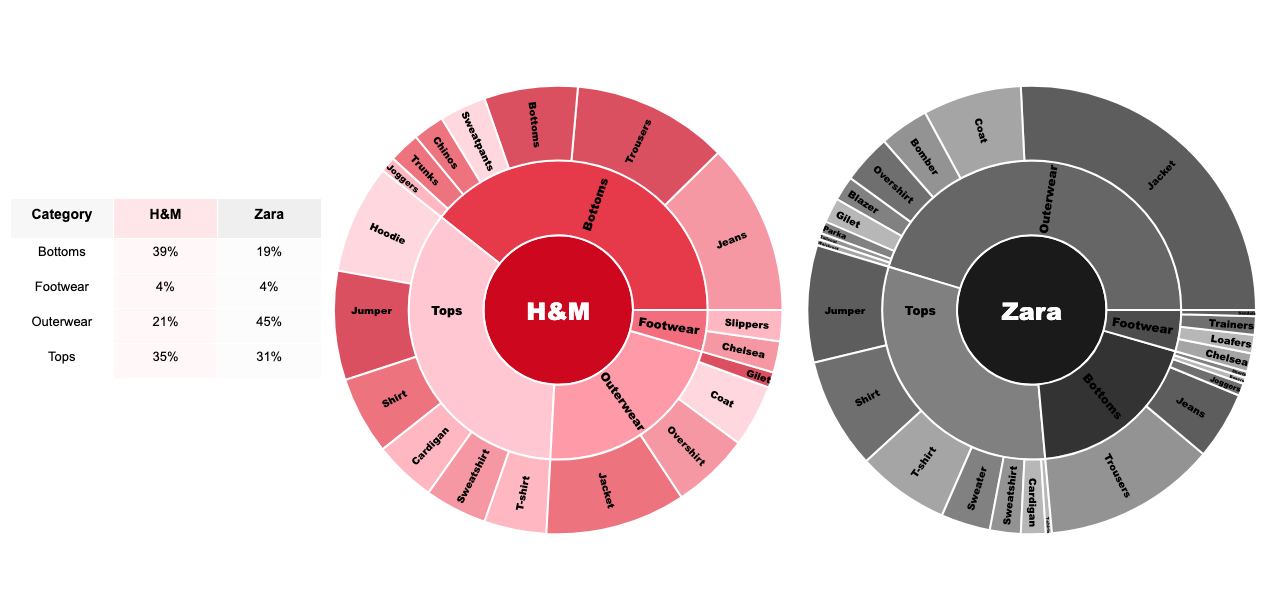 Fig. 1 - How H&M and Zara distribute their product assortment across categories. The charts show the proportion of products in each main category (Tops, Bottoms, Outerwear, Footwear) and their sub-categories, along with a summary table showing percentage breakdowns.
The price gap: blink and your wallet feels it
To keep things fair, prices were compared only within categories that both brands sell as best sellers, so this isn’t a case of pitting Zara coats against H&M T‑shirts.
We matched at the product-type level (for example, jeans with jeans and overshirts with overshirts) and then averaged across matched types without weighting for Zara’s longer list.
Even with that constraint, the gap is striking:
- H&M’s average price: £35.10 (67 items)
- Zara’s average price: £73.47 (191 items)
- Price ratio: Zara is roughly 2.1× more expensive overall
That price premium shows up most clearly in the area Zara focuses on the most: outerwear.
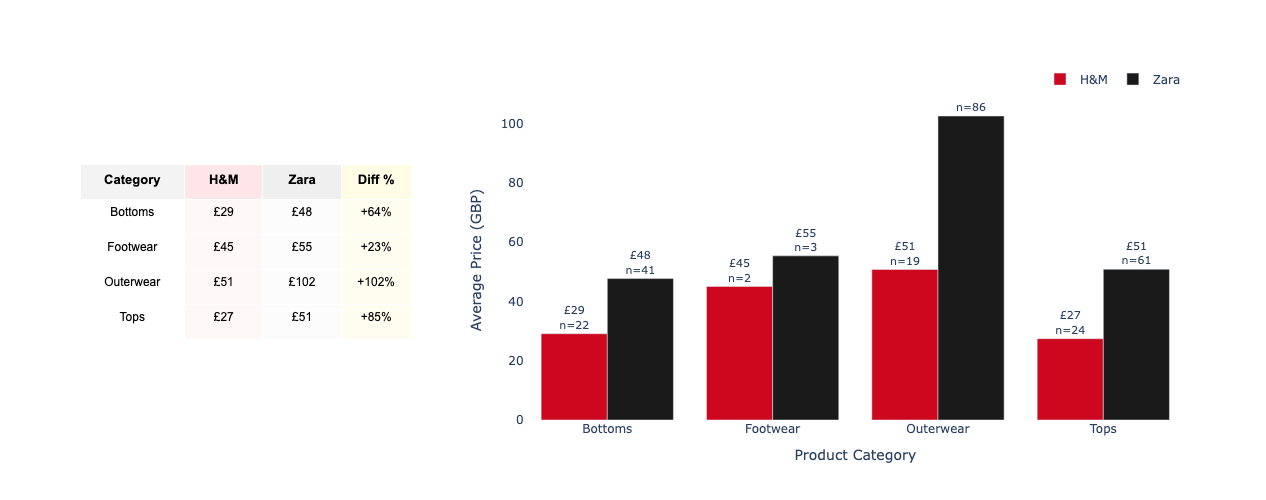 Fig. 2 - Average prices between H&M and Zara across product categories. Zara products are consistently more expensive across all categories.
So if you’ve ever felt like Zara “gets you” right when you’re shopping for a coat or jacket, that’s not accidental. Their best-seller mix suggests exactly that.
The plot twist: paying more doesn’t mean more natural fabrics
Here’s the twist that will annoy anyone who assumes price automatically means “better fabric.”
For each item, we looked at its listed composition and simply tagged whether each material was present, grouping them into natural/non‑synthetic versus synthetic. Those tags were then combined into a single material score for each product.
In practice: A higher score means a higher presence of natural fibres, for example an item made mostly from cotton or wool scores higher than one dominated by polyester or elastane blends.
The results?
When you average that out across comparable items:
- H&M: material score of 2.69
- Zara: material score of 2.40
In other words, H&M’s best sellers lean more natural overall, even though they’re significantly cheaper.
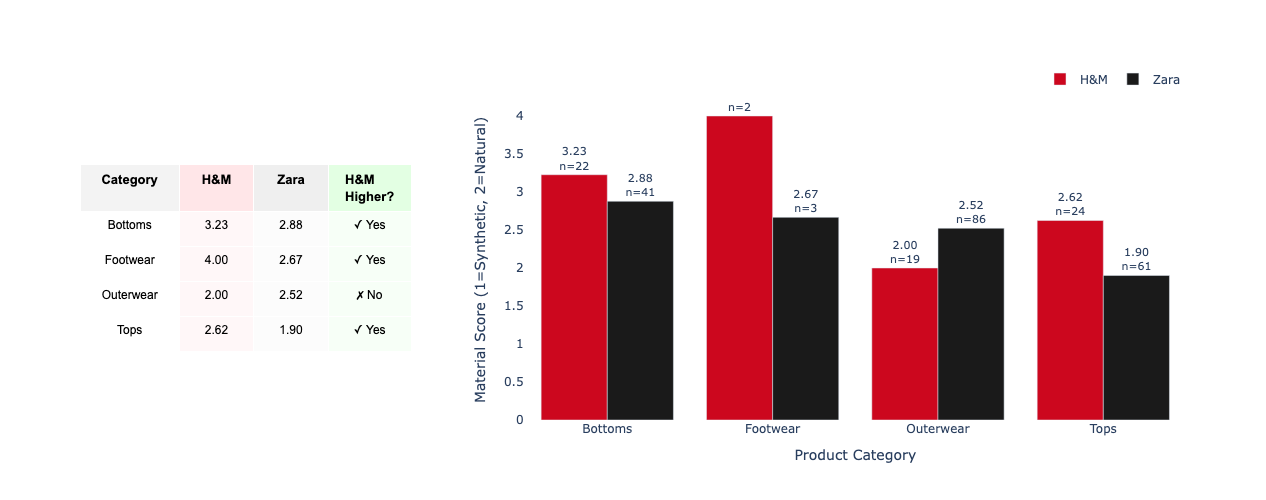 Fig. 3 - Comparison of material quality between H&M and Zara based on composition scores (1 = Synthetic, 2 = Natural/Non-Synthetic). H&M tends to use higher-quality materials with better natural fiber content across most categories.
What this suggests
Without pretending it proves “quality,” it’s simple: Zara’s premium is driven more by design, silhouette, brand positioning, and category focus than by consistently “more natural” materials. Outerwear is the exception. Zara seems to back up the pricing a bit more there.
Colour: playing it safe (and dressing in shades of grey)
There’s no mystery here: we buy safe, and best sellers are safe options.
When you look at the dominant colours of these products, both brands land in exactly the same place. Best sellers are designed to offend no one and work with everything.
In the UK especially, that translates into a sea of dark tones, blacks, charcoals, dark greys, and deep browns. It’s practical, versatile, and a little bit bleak. If you’ve ever felt like everyone on the street is dressed in some variation of grey-on-grey, the data backs you up.
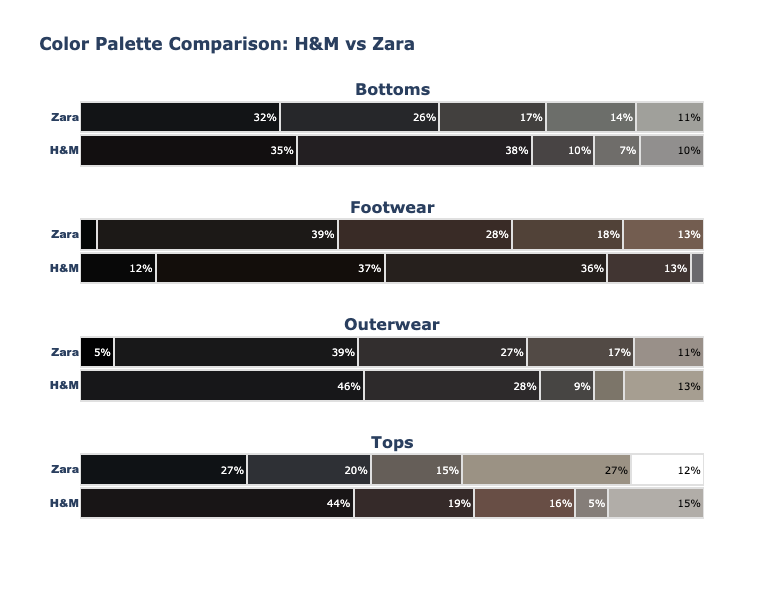 Fig. 4 - Color Palette Comparison between H&M and Zara. Similar color distribution between.
H&M leans hardest into very dark colours, particularly for bottoms.
Zara stays mostly neutral too, with a touch more variation here and there.
And yes, full disclosure: the blazer I mentioned at the start? A grey wool blazer. Of course it was.
So… what should you actually take away from this?
If you’re shopping based on what tends to sell the most - WHICH YOU SHOULD NOT DO!:
H&M’s best sellers
Look like a wardrobe foundation plan:
- Price: Cheaper on average (around £35)
- Focus: Heavily focused on bottoms and tops
- Materials: Tend to use more natural fibres than you might expect at that price point
- Colours: Neutral and practical, designed to slot easily into an existing wardrobe without much thought
Zara’s best sellers
Feel more like outfit-making pieces:
- Price: Roughly double (around £73)
- Focus: Anchored around outerwear
- Materials: Skew more synthetic overall, but coats and jackets show a stronger natural fibre presence
- Colours: Slightly more variation where it matters, particularly in outerwear and footwear
The “material-price paradox”
H&M is cheaper and more natural in materials for many best-selling categories. Zara’s premium seems to come from what they push (outerwear), how it looks, and the brand’s design and value perception, not raw fibre content.
Methodology and data details (for the curious)
Data source:
- UK websites for H&M and Zara, data manually collected in December 2025
- Scope: men’s products explicitly tagged as “best sellers”
- Counts: H&M 89 products, Zara 225 products
- Category groups: bottoms, tops, outerwear, footwear
Price comparison (downsampled / matched approach)
Brands don’t sell the same mix of items (Zara heavily favours outerwear), so averages can be misleading.
Our approach:
- Matched at the product-type level (for example, jeans with jeans, overshirts with overshirts, and similar like-for-like types)
- Averaged across those matched types without weighting for Zara’s longer list
Material scoring
Materials classified as:
- Synthetic (score=1): synthetic fibres, elastomer coatings
- Natural / non-synthetic (score=2): plant-based fibres, animal-based fibres, leather/suede
Score computation: Composition-weighted sum (so blends count proportionally)
Colour extraction
- Product images processed with background removal
- Colours converted to OKLab for perceptual consistency
- K-means clustering used to select a dominant colour
- Results aggregated by category group and brand
Analysis conducted January 2026 using December 2025 data.